Real-World Applicability of the HOTMA Verification Hierarchy for LIHTC
In February of 2023, HUD released H2023-10, officially bringing HOTMA to life in the world of affordable housing. This was truly the largest change that the industry had seen since its inception in 1986. Among many of the changes that rocked the industry, the concept and priority of verifications in a tenant file shifted.
For years, site managers and compliance teams were quick and efficient in sending out third-party verifications for almost any income or asset source. Now, under HOTMA, the term “third-party” doesn’t even seem to mean the same as it once did. The process of completing tenant files was rewritten, and a new method was brought to the table.
No longer was it the responsibility of the site to obtain documentation directly from the income and asset source. LIHTC projects would now shift to the HOTMA Verification Hierarchy, which prioritizes applicant/tenant provided documents. This was an uncomfortable change for many; the purpose of managers gathering the information directly from the source was thought to prevent possible altered documents or partial information.
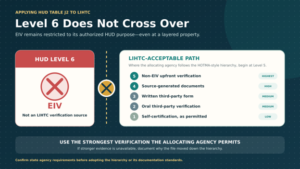
The shift was foreign enough that the purpose of the hierarchy seemed lost. The industry was provided this new method meant to take work off the sites and shift the responsibility of document gathering to the applicant/tenant. Projects finally had a way to make a little more time for other tasks instead of chasing down documents. But it seems as though that “extra time” is now being used on determining which documents should be gathered, which documents are acceptable and preferred, and how to resolve inconsistencies or anomalies in the documents.
Sites must remember why they are asking for certain information in the first place and think about the documentation that would best fit. Below are some examples of common types of income and assets, what is acceptable and what is not, how the documents should be obtained, and how to utilize the information that is provided. This list is not exhaustive and does not cover every scenario.
Employment
When verifying income, the site is looking to answer the following questions:
- What is the rate of pay and the frequency worked?
- Are overtime, commissions, bonuses, or other payouts expected throughout the year?
- Are any changes to pay rate or hours worked expected within the next year?
- Is there a layoff period, and if so, are they eligible for employment?
Under HOTMA Verification Hierarchy, the site should not move directly to a Verification of Employment, but should be utilizing the following processes instead:
- If the site has access to The Work Number, Experian Verify, or other automated payroll or employment-verification systems this is now the preferred verification method. Ensure that the report answers all questions above.
- If additional information or clarification is needed, note that a self-certification from the applicant/tenant themselves is considered the lowest form of verification. Look to either obtain written third-party clarification or appropriate oral verification, as these methods are both considered the same level under the new hierarchy.
- If an upfront income verification is not available, move directly to paystubs. Ensure that paystubs contain necessary information, such as name, pay period and pay date, hours worked, rate of pay, gross pay, frequency of pay, and any other relevant earnings. HOTMA requires a minimum of 2 consecutive paystubs (ensure they are current), but your Housing Finance Agency or investor may require additional paystubs.
- If additional information or clarification is needed, note that a self-certification from the applicant/tenant themselves is considered the lowest form of verification. Look to either obtain written third-party clarification or appropriate oral verification, as these methods are both considered the same level under the new hierarchy.
Unearned Benefits
When verifying unearned benefits, the site is looking to answer the following questions:
- What is the gross amount of benefits received?
- What is the frequency in which benefits are received?
- Is there a current or upcoming circumstance in which the benefit amount would change in the next 12 months?
Ensure that the applicant/tenant is first attempting to provide these documents to the site. This means the applicant/tenant should be calling, or otherwise reaching out to, the source of this income and requesting documentation to bring to site management. Sites requesting this documentation on behalf of the tenant are only following a medium level of verification on the hierarchy and skipping the highest level of verification.
Multiple sources of unearned benefits now provide self-service methods to access income information. Many states, along with the Department of Labor and other government offices, have created websites and portals in which the applicant/tenant can access proof of benefits immediately.
Self-Employment
This process has not changed as drastically as others under HOTMA. The site should be looking to answer the following questions:
- What are the anticipated net earnings for the next 12 months?
- What were the net earnings earned in the year prior?
The information used to answer these questions has shifted somewhat due to the increase in gig work. Under HOTMA hierarchy, the site should be looking for the following documentation:
- Many gig jobs, such as Walmart Spark, Uber, Instacart, DoorDash (along with countless others) have their own platform in which the worker can access weekly and/or monthly pay statements. These can be collected and averaged, similar to paystubs for traditional employment. Remember that gig work can always include earned tips, which must also be verified as earnings.
- If it is true self-employment, outside of standard gig work, the site must ask for the last year’s tax return (if the business existed in the last year) or Profit and Loss statements for the current year (for a new business). Moving directly to a self-certification from the applicant/tenant skips every other step and is considered the lowest level of verification.
This is an instance where following the hierarchy is more difficult – always ensure you have exhausted higher forms of verification AND noted the file as to why you have used a lower form of verification.
Financial Account Statements
Gone are the days of a simple Bank Verification document. HOTMA hierarchy directs the site to obtain written third-party verification from the source first, meaning a bank or financial account statement. This was considered easier to obtain, as it should be directly accessible by the applicant/tenant. Unfortunately, an unintended (or maybe purposeful?) consequence of collecting these documents is that it opens a can of worms. Now, instead of a 6-month average and an interest rate, sites have access to review an entire month, or more, of financial transactions.
Sites must now take an additional step when collecting and reviewing these documents, as multiple items found in the statement can affect income and asset calculations and eligibility. Review the full statement, including all transactions, and realize that the following items could now be on a document in the file and must be properly verified. Note, this is not an exhaustive list.
- Payroll direct deposits: Ensure these deposits match paystubs that have been provided. This can reveal a source of undisclosed income which must be verified.
- Consistent money movement outside of the household: Internet apps have created a method for fund transfers that have become a part of daily life. Deposits should be verified as either one-time occurrences or ongoing transactions that would need to be counted as income.
- Donations: Most people would not normally consider donations to a program, group, or church to be a “disposed asset.” But they are – and HOTMA removed the $1,000 minimum threshold before disposed assets are counted. Verify any donations and include them as disposed assets to the household.
- Additional assets: Look for transactions/transfers from an account number that was not disclosed or verified; do the same for internet apps. A life insurance policy could be listed as a payment on the bank statement; this is considered an asset to be verified.
- Gambling activity: The prevalence of gambling has increased every year. Activity can be noted on a bank statement that funds are being deposited into a gambling account or winnings are being received from the same. Gambling creates an income and asset, both of which need to be verified.
In addition to these items, bank statements will disclose interest rates that may not have been considered previously. Ensure that the financial statement lists the interest rate or dividends earned on appropriate accounts. If there is any confusion or discrepancy, use level 3 or 2 to obtain clarification, as these would be the next verification steps. Do not move directly to a self-certification unless the file is thoroughly noted as to why other verification methods could not be utilized.
Of course, this is only the tip of the iceberg when diving into the new HOTMA Verification Hierarchy, but these are some of the biggest changes that truly change how a site completes a tenant file moving forward. The change forces us to analyze documents that we receive, observe any additional forms of income or other assets, and a specific order in which we should be obtaining documents in the first place.
Owners and Management Agents should be well trained in understanding the rules and regulations of the affordable housing programs pertaining to their properties as they relate to maintaining compliance. MLCM offers consulting services and training regarding various affordable housing programs. For more information on these services, don’t hesitate to contact us.
The information presented in this article is intended solely for informational purposes and should not be construed as consulting advice from M&L Compliance Management LLC.
About the Author

Becky joined MLCM in September 2025 as a Housing Compliance Consultant. She has extensive experience in the affordable housing industry, beginning her career in property management as both an on-site manager and resident services coor… Read more